by Larry Owens


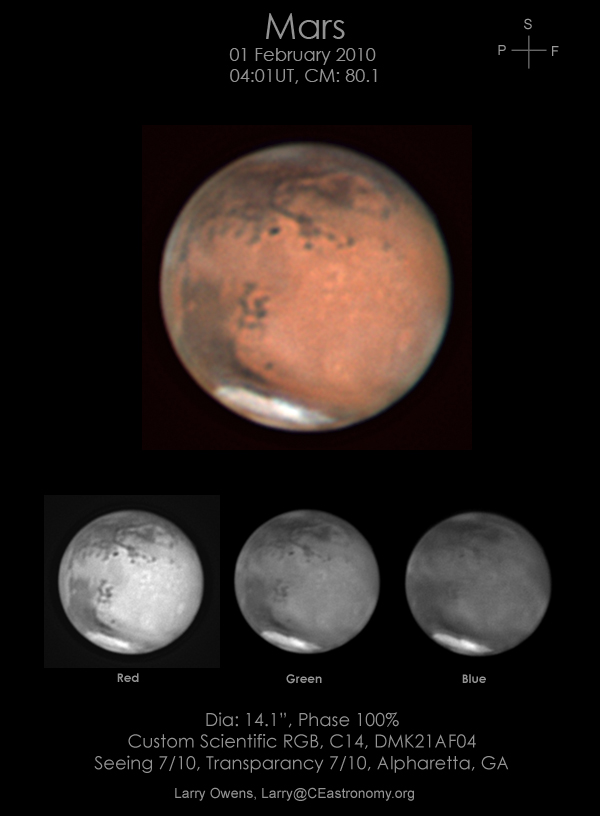
Mars, 02/01/10 @ 04:01UT

7 February, 2010 (02:24) | Uncategorized | By: ltowens

Hello everyone,

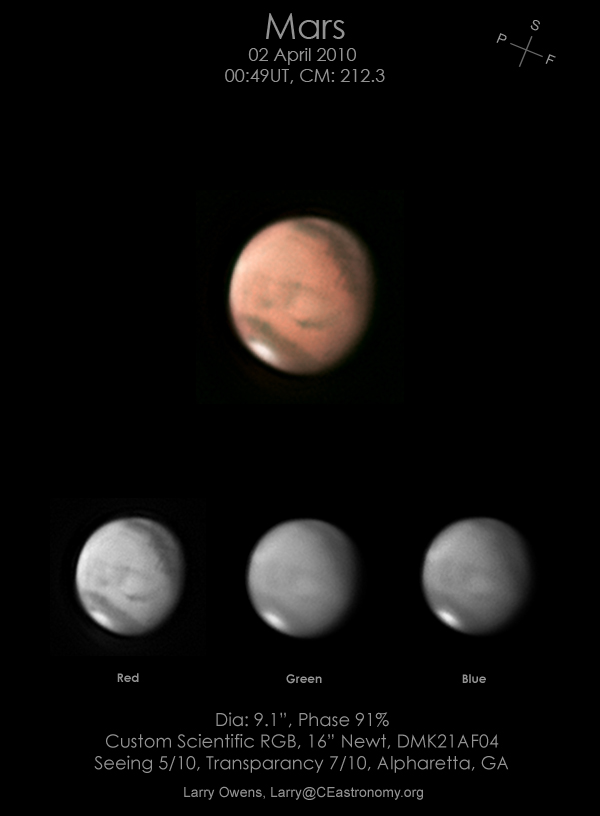
I was able to get a relatively good image of Mars, the morning of Feburary 1st.  It shows some interesting north polar detail, including dust.  I took a total of 4 sets that morning, but haven’t had the chance to process them.  The seeing conditions (stability) were rather good for a change.

mars_020110_0401uta

Dark skies,

Larry

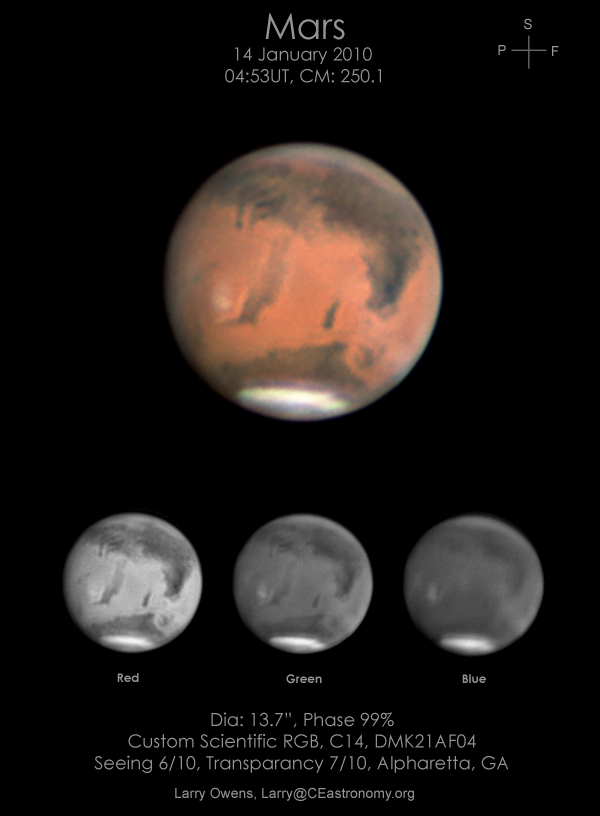
Mars Jan 14th @ 04:53UT

17 January, 2010 (10:58) | Uncategorized | By: ltowens

The opposition is approaching as you can see in this nearly “full” phased Mars image.  The seeing from Alpharetta was relatively good for a change onthe evening of the 13/14th.  This shot was taken with the red planet at about 50 degrees elevation, using the C14.

mars_011410_0453ute1

Dark skies,

Larry

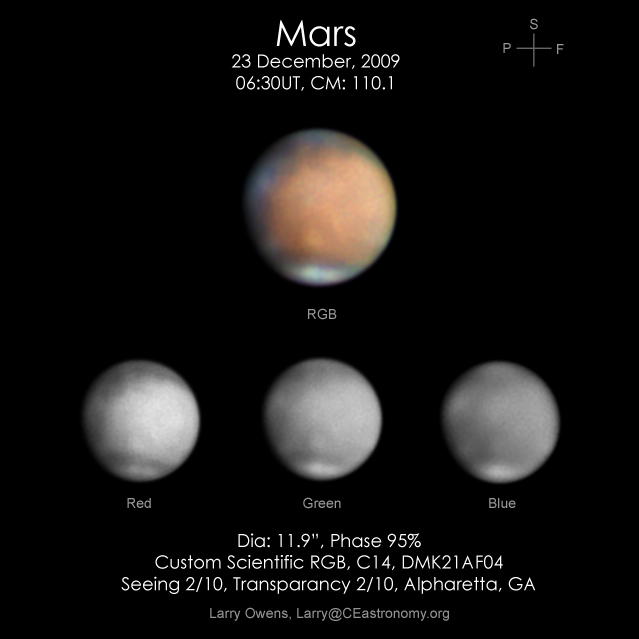
Mars Image, Dec 23, 2009

24 December, 2009 (14:25) | Uncategorized | By: ltowens

I was able to do some imaging on the 23rd and the result is below.  It isn’t a particularly interesting image due to the conditions but at least I was able to get a shot of the red planet.  I also haven’t had a chance to check the collimation of my scope lately, so that may have contributed to the lack of detail.

The sky was filled with waves of high thin clouds, and a large bank of clouds approaching from the SW, but there was enough time to catch the red planet just above 40 degrees in elevation.   I did have to limit the number of frames captured because of the approaching clouds.

As usual the image was taken with a DMK21AF04, and Custom Scientific RGB filters, attached to the C14.

mars_122309_0630ut

Dark skies,
Larry

Mars is Approaching

29 November, 2009 (13:50) | Mars | By: ltowens

Hello everyone.  The planet Mars is fast approaching for an opposition this January, so it’s time to sharpen your imaging skills.  Although this will not be the best opposition we’ve had recently, at 14.1″ in apparent size on January 27th the planet will be large enough for amateurs to capture a lot of detail.  Here are some key dates for the event (courtesy SEDS):

Key Dates for Mars this Opposition

Dec 1, 2009
Mars leaves constellation Cancer and enters Leo.
Dec 3, 2009
Apparent diameter of Mars exceeds 10″.
Dec 21, 2009
Apparent brightness of Mars exceeds -0.5 mag.
Dec 22, 2009
Mars becomes stationary and then starts its retograde opposition loop, as Earth passes between the Red Planet and the Sun.
Jan 1, 2010
Mars shines at mag -0.77 in constellation Leo with an apparent diameter of 12.67″. Distance from Earth is 0.73885 AU (111 million km).
Jan 9, 2010
Mars leaves constellation Leo and enters Cancer again, during retograde opposition loop.
Jan 11, 2010
Apparent brightness of Mars exceeds -1.0 mag.
Jan 27, 2010
Closest approach of Mars and Earth (0.664 AU = 99.33 million km). Apparent diameter of Mars is 14.105″.
Jan 29, 2010
Mars opposition on Earth, Earth in inferior conjunction on Mars. Apparent brightness of Mars reaches -1.28 mag in constellation Cancer.
Feb 14, 2010
Mars’ apparent brightness becomes fainter than -1.0 mag.
Feb 21, 2010
Mars at its greatest northern heliocentric ecliptic latitude (+1.8489 deg).
Mar 5, 2010
Mars’ apparent brightness becomes fainter than -0.5 mag.
Mar 11, 2010
Mars becomes stationary to end its retograde opposition loop as the Earth has passed it on its inner orbit, and proceeds in prograde apparent motion.
Mar 22, 2010
Apparent diameter of Mars decreases below 10″.
Mar 25, 2010
Mars’ apparent brightness becomes fainter than 0.0 mag.
Mar 30, 2010
Mars moves beyond 1.0 AU distance.
Mar 31, 2010
Mars in Aphelion (1.66594 AU, 249.2 million km).

.

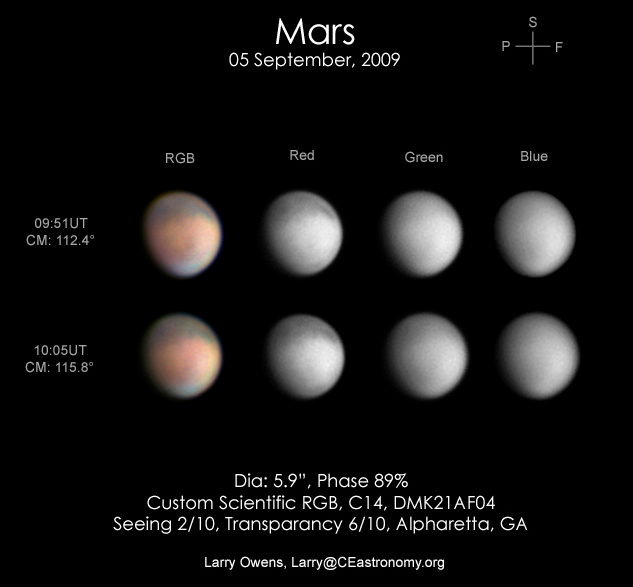
Although I haven’t been able to image recently, here are some images from August and September (by the way, this first image will appear in the February issue of Sky and Telescope magazine):
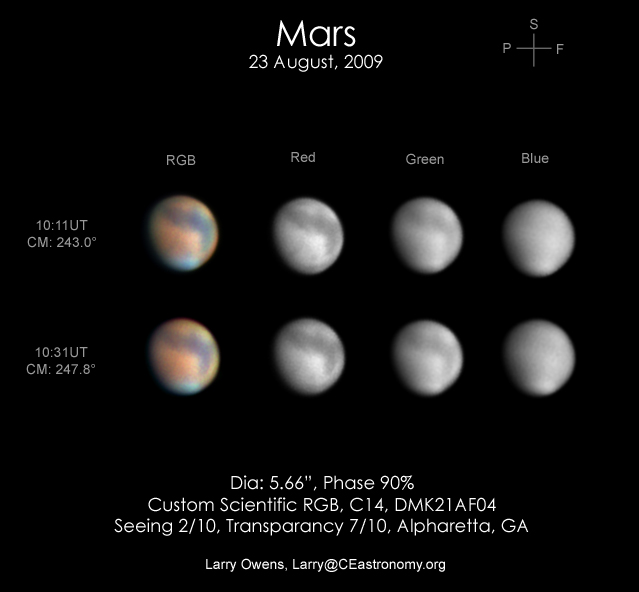
mars_082309_1011ut_1031uta_medvert

mars_090509_0951ut_1005ut_medvert

Dark skies, and get out there and image!

Larry Owens

Imaging the planets is rewardi…

29 November, 2009 (12:02) | Twitter | By: ltowens

Imaging the planets is rewarding and contributes to science. Learn how! http://ceastronomy.org/gallery/main.php?g2_itemId=39

A Busy Year

11 October, 2009 (14:41) | Uncategorized | By: ltowens

This has certainly been a busy year for astronomy.  Earth passed through Saturn’s ring plane which presented a rare view of the planet, nearly without its magnificent ring system.  Jupiter received a rather large impact, discovered by fellow amateur astronomer Anthony Westly which inspired all of us to renew our efforts to observe and image the great planet.  Now our old friend Mars is returning for an opposition early in 2010.

Unfortunately for me, I’ve been very busy with work and family and just haven’t had the time to image the planets to the extent of previous years.  I did manage however to image Saturn, Jupiter and Mars, and hope to spend more time imaging as Mars approaches.

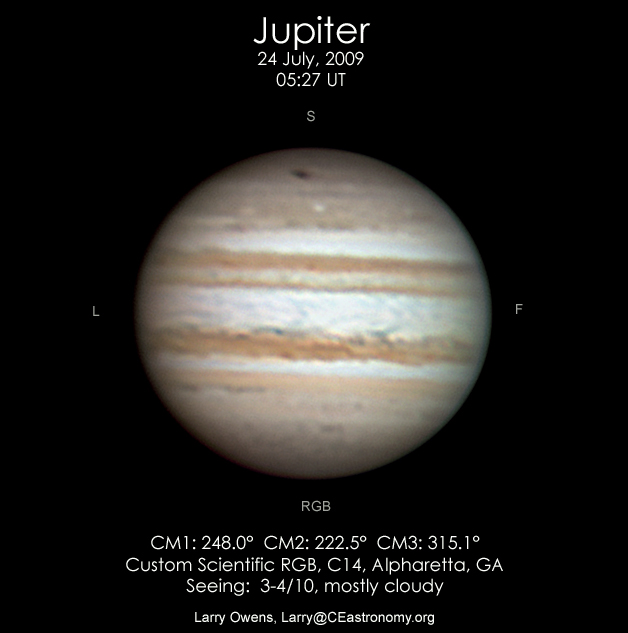
Of course I wanted to capture the great Jupiter impact event of 2009.  Here’s a shot taken July 24th,  which was several days after the impact event (July 19th).  My site is not optimum for Jupiter at this low altitude, so the stability from heat rising from my neighbor’s roof usually softens images quite a bit.

.

jupiter_072409_rgb_0527ut

.

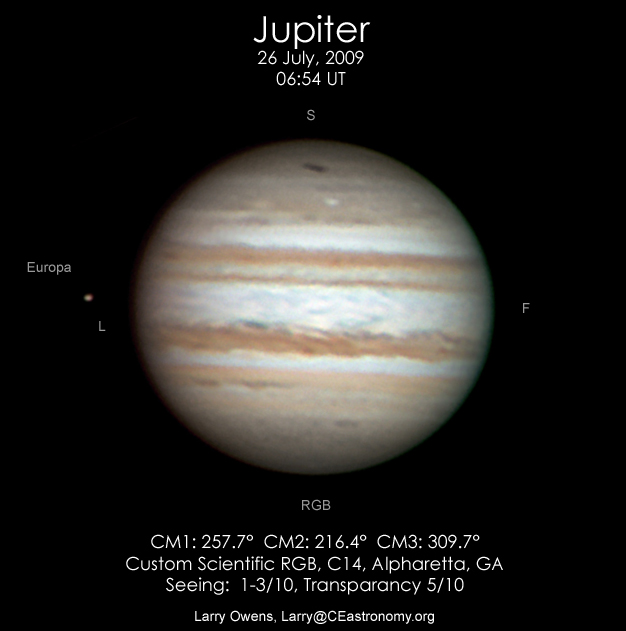
Here’s another shot of the impact (below), taken a couple of days later, and you can see that the impact seemed to elongate somewhat.  The impact was actually visible for several weeks.

jupiter_072609_rgb_0654ut

.

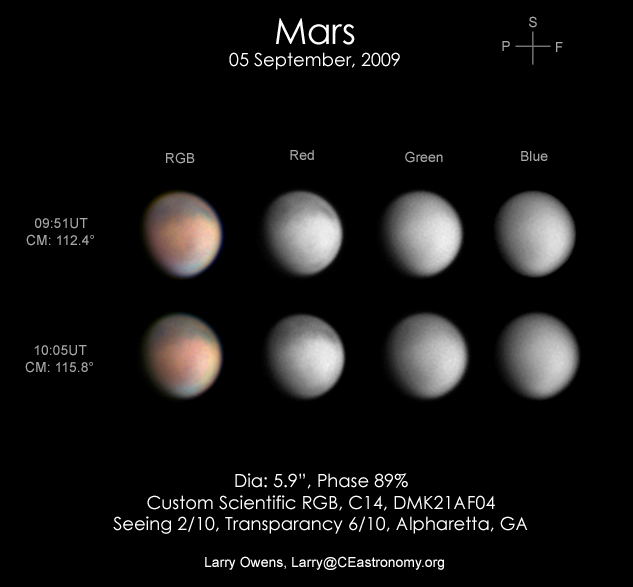
Below is the most recent shot of Mars.  The planet was still a tiny target, at just under 6″ of arc in this image.  Currently Mars is much larger at 7″ of arc as Earth catches up to the red planet.  It also rises to nearly 70 degrees high just before sunrise now which, coupled with the larger size should present much more detail.  We’ve had terrible weather lately but I’m hoping to image the planet again very soon.

mars_090509_0951ut_1005ut_medvert

.

For the latest images, please take a look at my gallery.

Dark skies, Larry

RegiStax v5 and Saturn

8 March, 2009 (22:41) | Registax, Saturn | By: ltowens

Jim Honeycutt reminded me this past Saturday that RegiStax 5 is available in beta, so since I haven’t been able to image lately, I decided to download it and give it a try on some earlier sets. 

This image was processed with version 5.  I hadn’t bothered to process this set because of the softness of the avi’s.  This one was taken at 07:37UT on February 1st, 2009, CMI: 161.5  CMII: 122.9   CMIII: 14.2:

2009-02-01_02-37-26_rgb_v5_wv_stage1_lrgb_flat_stg2

The avi’s were bouncing around somewhat with a seeing estimate of 3-4/10.  It was taken with a Skynyx2-0M and C14 at F/25.71; Custom Scientific RGB filters.

I was somewhat happy with the results, especially since I’d given up on this set.  Registax5 seemed to pull out some interesting detail from very limited data.


The following is a comparison of the same image processed by Registax4 and 5.  In this comparison, the v5 image seems to have more noise, but I may have gone too far with wavelet processing on my first try with v5.  I typically apply wavelets modestly and let PhotoShop do the rest, but I wanted to test the limits.

2009-02-01_01-39-49_v5_rgb_stage1_v4_v5_compare

I’m happy to see progress on this excellent FREE software for stacking astronomical images.  Being a programmer myself, I know that developing software like this takes hundreds if not thousands of hours of work by dedicated individuals.   Many thanks to the Registax version5 team!

Download RegiStax version 5 here (beta now - released version soon).

Larry

Saturn, February 2009

28 February, 2009 (17:34) | Saturn | By: ltowens

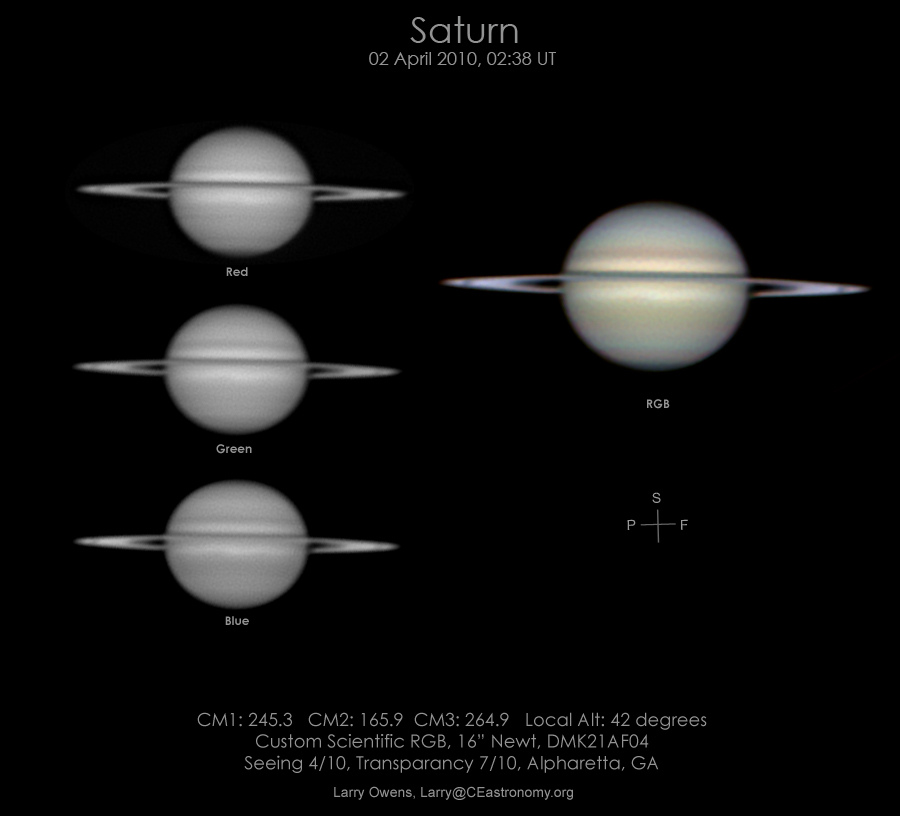
This set of images was taken under slightly better skies and actually picked out one of Saturn’s recent equatorial storms (just under the rings, left of center).  I also imaged in the Methane band, which gives the planet an oddly bright set or rings.  The soft appearance of the Methane shot is due to a 2.5 second exposure per frame. (Click image for a larger view)

saturn_020109_rgb_m_alt_2

Saturn, December 2008

28 February, 2009 (17:28) | Saturn | By: ltowens

From the fall of 2008 through the winter of 2009, Earth will be near Saturn’s ring plane, giving us an edge-on view of the rings.  Here’s an image taken under somewhat turbulent atmospheric conditions, but it certainly shows the edge-on appearance of the rings (click image for larger view):

saturn_123008_rgb_m_alt_2

Jupiter, September 2008

28 February, 2009 (17:11) | Jupiter | By: ltowens

Here are 2 sets of Jupiter taken in Sept, showing the Great Red Spot and Oval BA (near the limb).  The image was taken under intermittien cloud cover and relatively poor stability.  Click image for full sized view.

jupiter_2sets_090508 

Here’s another September image with somewhat more detail, but of a somewhat less interesting part of the planet.


jupiter_irgbm_0913081 


And here’s a slightly enlarged version of the same image presented alone:

 2008-09-13_21-15-15_2500_irrgb_stage2_2x1